Building #51
Developing thinking about the purism-decorism continuum

In my previous post (Building #50), I offered a schematic for a continuum of purism and decorism, which essentially describes tendencies towards very simple building design (purism) and highly complex building design (decorism). I also provided some actual examples of what I meant by this.
In response to the post there has been a very helpful suggestion of inserting a third axis into the schematic related to materials, technology and digitalization. Having reflected on this, the second iteration of the continuum therefore looks like this:
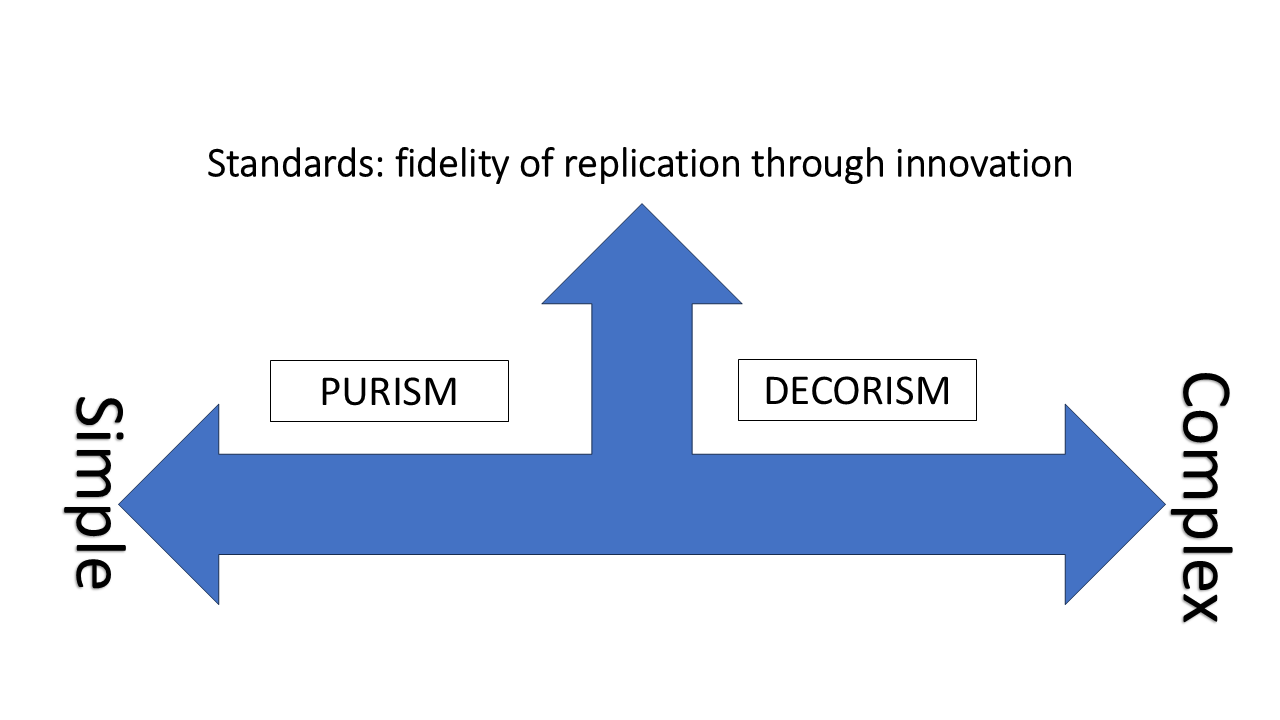
The iteration shows a vertical axis influencing the horizontal axis of the continuum of purism and decorism in building design. The new axis shows the fidelity of replication within building design, connected as it is with continuous innovation in design and construction. The term ‘Standards’ is used to describe this potentially rather complex package.
Standards are agreed outcomes of normalisation processes at set points in time (my own definition - you can see the much longer Wikipedia description of standards here: https://en.wikipedia.org/wiki/Standard).
In building design there are technical/industrial standards, as well as professional/personal standards. An instance of the former are Eurocodes, which guide the structural aspects of building design. An instance of the latter are the skills and other attributes possessed by competent building design professionals. If you want to use the professional title ‘architect ‘in the UK, you must have received appropriate specialist training and you must abide by agreed rules of conduct/practice (see the RIBA website).
I will describe in later posts what I mean by ‘fidelity of replication’ and ‘innovation in design and construction’ and how they relate to standards. I will also look at the implications of the new vertical axis sitting towards one or other end of the continuum of purism and decorism.
In the meantime, here is an interesting historic building, one of many that I’m looking at currently as part of the background research for my new book.
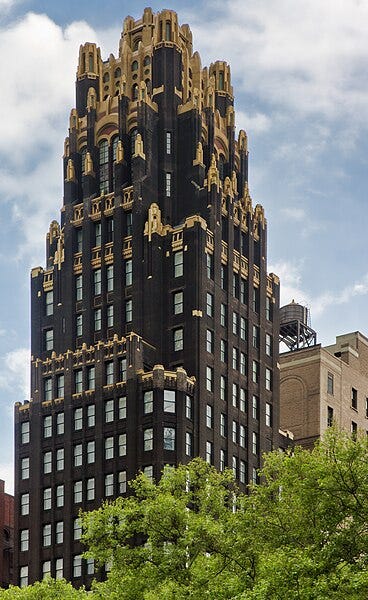
It is taken from a Wikipedia entry on ‘Art Deco’ as an art style and shows the American Radiator Building skyscraper in New York City (completed in 1924), which also has its own Wikipedia entry. The architects were Raymond Hood and André Fouilhoux.
I see ‘Art Deco’ architecture as a useful intermediate style along the continuum of purism versus decorism, with many sub-genres within it. It also has some simple and some complex building design features to it. So where exactly does it (and/or the American Radiator Building) sit on the continuum? Discuss …